


Efoil on Koh Phangan: Electric Foilboarding on a Tropical Island
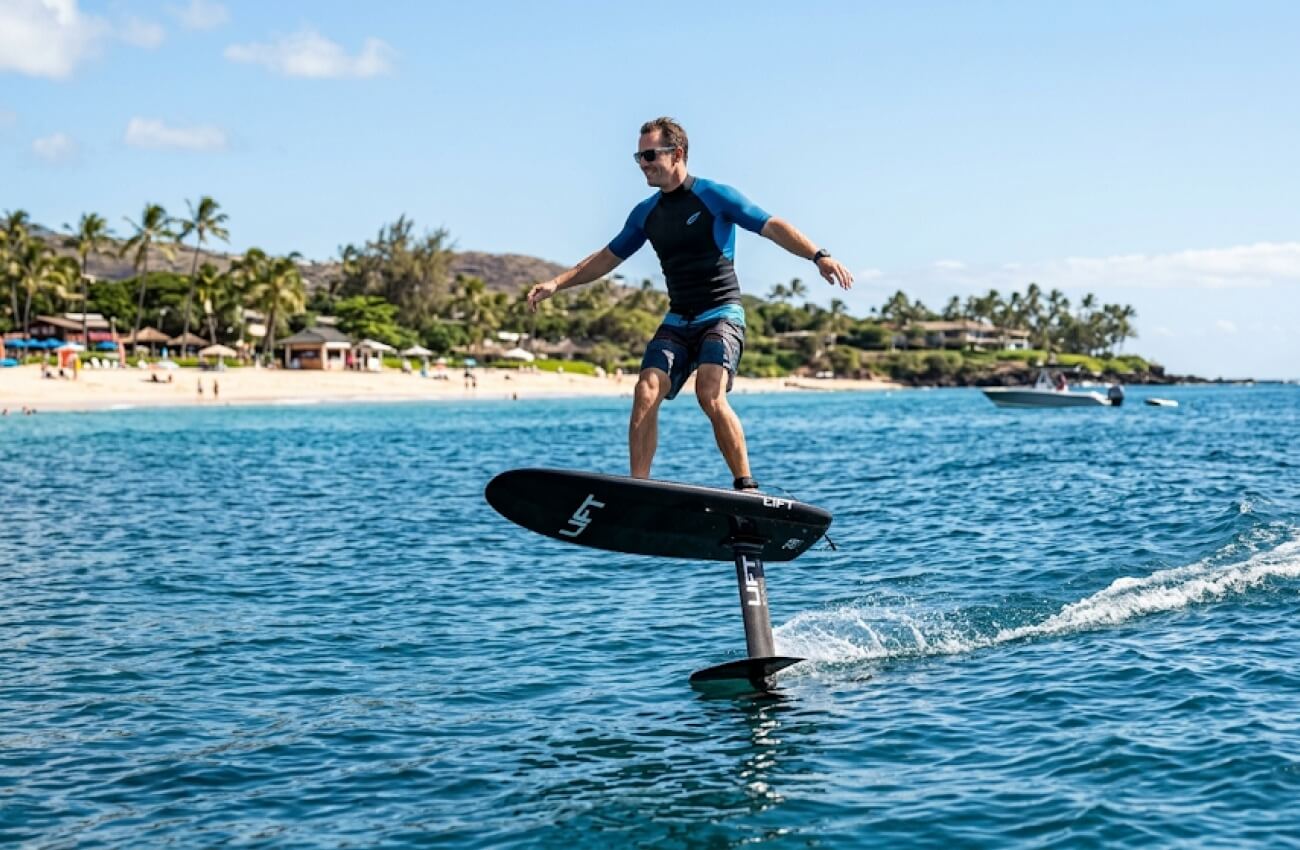
Koh Phangan has a reputation that arrives before the island does. Most people who come here are thinking about the party, the yoga retreats, the slower pace after Koh Samui. What they don’t expect is to spend a morning standing above the water on an electric foilboard, watching the bay surface drop thirty centimetres below the hull while the motor runs in near silence underneath them.
That’s the detail that stays with people. Not the speed — though the board is capable of reaching 50 km/h on the foil setup we use. Not the technical complexity, which is lower than most expect. It’s the quiet. The electric hydrofoil produces almost no noise at operating speed, which means the experience of flying above the water on Koh Phangan’s northern bay is genuinely unlike anything else the island offers. You hear the wind, the water below you, and very little else.
This article is about what efoil on Koh Phangan actually involves — why Chaloklum Bay works as a training spot, what a first session looks like from start to finish, and what the island’s conditions mean for how fast you progress.
Chaloklum Bay: why the geography matters for learning
Not every beach works for electric foilboarding instruction. The foil mast needs consistent depth between 1.5 and 2.5 metres to operate without contacting the bottom, the session area needs to be clear of boat traffic, and the surface needs to be calm enough for a first-timer to feel the board’s feedback rather than react to chop.
Chaloklum ticks all three. The bay sits on the island’s northern coast, sheltered by headlands on both sides that buffer most wind and swell directions. The seabed is sandy throughout the session area — no reef, no rocks, nothing that makes a fall feel consequential. Water depth in the training zone holds steady around 1.5 to 2 metres, which is enough clearance for the hydrofoil to function cleanly from the first run.
What this translates to in practice: students at Chaloklum spend their session learning to ride, not managing environmental variables. One pattern we observe consistently is that newcomers who train in genuinely calm, shallow conditions adjust to the board’s feedback within the first twenty to thirty minutes. The noise level matters here too. A quiet motor on flat water means the body picks up the foil’s subtle cues through the feet rather than filtering them through surface turbulence.
The bay runs year-round. November through March is the peak window, when the Gulf of Thailand settles into its dry season rhythm and visibility through the water column is at its best. Sessions are available outside that window too — the electric foilboard doesn’t require wind, which means most weather short of a genuine storm keeps the bay rideable.
A first session at Chaloklum: what happens hour by hour
Every beginner session at EasyFlyFoil opens on the beach with ten to fifteen minutes of structured theory. Three topics: how the wireless throttle remote responds to input pressure, what fore-and-aft weight shift does to the board’s altitude, and how to fall without the board or foil becoming a hazard. That last part gets less attention from students before the session than it should, and more attention afterward than anything else we cover.
Then into the water. First-timers start prone on the board, remote in hand, learning how little throttle input the board actually needs to start moving. The foil mast — about 70 cm below the hull — begins generating lift as speed builds, and the board rises gradually rather than suddenly. The moment the hull first clears the surface, most riders freeze. It lasts about a second. Then the body takes over.
By the thirty-minute mark in most sessions, students are upright. Throttle open, weight centred, watching the water surface pull away beneath them. Over 80% of first-timers reach that point within the first class. The 60-minute session costs 3,500 THB and includes the coach, helmet, buoyancy vest, lycra, walkie-talkie receiver, and phone filming through a waterproof housing at no extra charge.
That walkie-talkie detail is worth focusing on. The coach stays in contact with you throughout the entire session, not just between runs. When your weight is drifting forward and the nose is about to drop, the correction arrives in your ear at exactly the right moment. The body links the instruction to the physical result immediately. That compression of the feedback loop is a significant part of why the first-session numbers are what they are.
Mastering the Foil: From First Flight to Independent Riding
The intermediate session — priced between 2,000 and 3,500 THB depending on duration — shifts the focus from achieving lift to controlling it. Edge management, throttle modulation through turns, recovering from altitude changes without losing the flight. Students who return the day after their first session almost always find the adjustment period dramatically shorter than they expect.
For riders who want to leave the island with a transferable skill rather than a single memory, the five-day package starting from 8,500 THB is structured around exactly that goal. The arc runs from first flight on day one through directional riding, speed variation, and independent control by day five. Most students who complete the full programme can take the board out on rental without a coach alongside them.
One practical note: maximum rider weight for our boards is 100 kg. No prior board sports experience is required. You need to be comfortable in the water, but the session area depth and sandy bottom mean that falling off the board is inconvenient rather than dangerous.
How Koh Phangan fits into a wider Thailand trip
The two locations we operate serve different calendar windows. Efoil surf in Phuket at Kata Beach runs April through October, when the Andaman coast is at its calmest. Koh Phangan covers the other half of the year, with its peak overlapping precisely with the period when Phuket slows down.
For travelers splitting time between the two coasts, the progression transfers directly. Same equipment standard, same session structure, same coaching system with the walkie-talkie in the water. A student who reaches upright riding on Phangan and continues at Kata Beach picks up where they left off. The drone video add-on — footage shot from above with editing, at 2,000 THB — is available at both locations for those who want a visual record of the full progression arc.
The team at Chaloklum works in English, Russian, Ukrainian, and Thai. To check session availability or ask about the package options, reach us at +66 62 015 1052, info@easyflyfoil.com.
Chaloklum in December, early morning, flat water, motor barely audible. That’s the session most people describe when they tell someone else about it afterward.

E-foil surfing instructor
Hello, fellow sailors! My name is Anton and I am your guide in the world of surfing. Let’s dive into the waves together!