


eFoil Lessons on Koh Phangan: From Zero to Flying Above the Water
“How many lessons will I need before I can actually fly?”
We get that question almost every day. And the answer, which still surprises most people who ask it, is: usually one. Not one week. Not one certification course. One 60-minute session, and the majority of people who walk into the water with no board sports background at all leave having felt the board lift off the surface with them on it.
That’s not a sales line. It’s what we observe every season at Kata Beach. The combination of flat water, the right gear setup, and real-time coaching through a walkie-talkie changes the learning curve significantly compared to what most people expect from a new water sport.
Here’s what the progression actually looks like, from the moment you arrive to the moment you’re standing above the water.
What you’re working with before you touch the water
Every session at our efoil school in Phuket opens on the beach, not in the water. Ten to fifteen minutes of theory that covers three things: how the wireless throttle remote responds to input, what your weight distribution does to the board’s altitude, and how to fall without turning a tumble into something worse.
The gear you’ll be wearing: a helmet, buoyancy vest, and a lycra layer that protects against the board’s surface on impact. You’ll also have a small walkie-talkie receiver on you the entire time. That last item gets underestimated until students are actually in the water and realise the coach is talking them through corrections in real time rather than waving from the shore.
Efoil hardware with a hydrofoil mast roughly 70 cm below the hull. The electric motor is silent — genuinely quiet in a way that catches people off guard the first time they open the throttle. The battery gives about 90 minutes of continuous ride time, which comfortably covers a first session with room to spare.
The first ten minutes: prone, moving, finding the feel
You start lying flat on the board. Throttle in your right hand, chin up, weight centred. The first goal isn’t lift. The first goal is getting comfortable with how the board responds to small throttle changes while you’re horizontal.
One thing we observe in almost every beginner session: the instinct to squeeze the throttle harder when the board wobbles. It’s the wrong response. More speed before you’ve found your balance point pushes the nose down or sends you sideways. The correction is usually smaller than people expect — ease off slightly, redistribute weight back, let the foil find its angle.
Most riders get their first accidental lift in this phase. The board rises two or three centimetres, holds for half a second, and drops back down. It doesn’t feel dramatic. But it’s the signal that the mechanics are working and the body is starting to read the board correctly.
First eFoil Flight: What to Expect After 30 Minutes of Riding
This is where sessions tend to split. Some students are upright by minute twenty. A few take the full hour. What separates them usually isn’t athletic ability — it’s willingness to stop muscling the board and start listening to it.
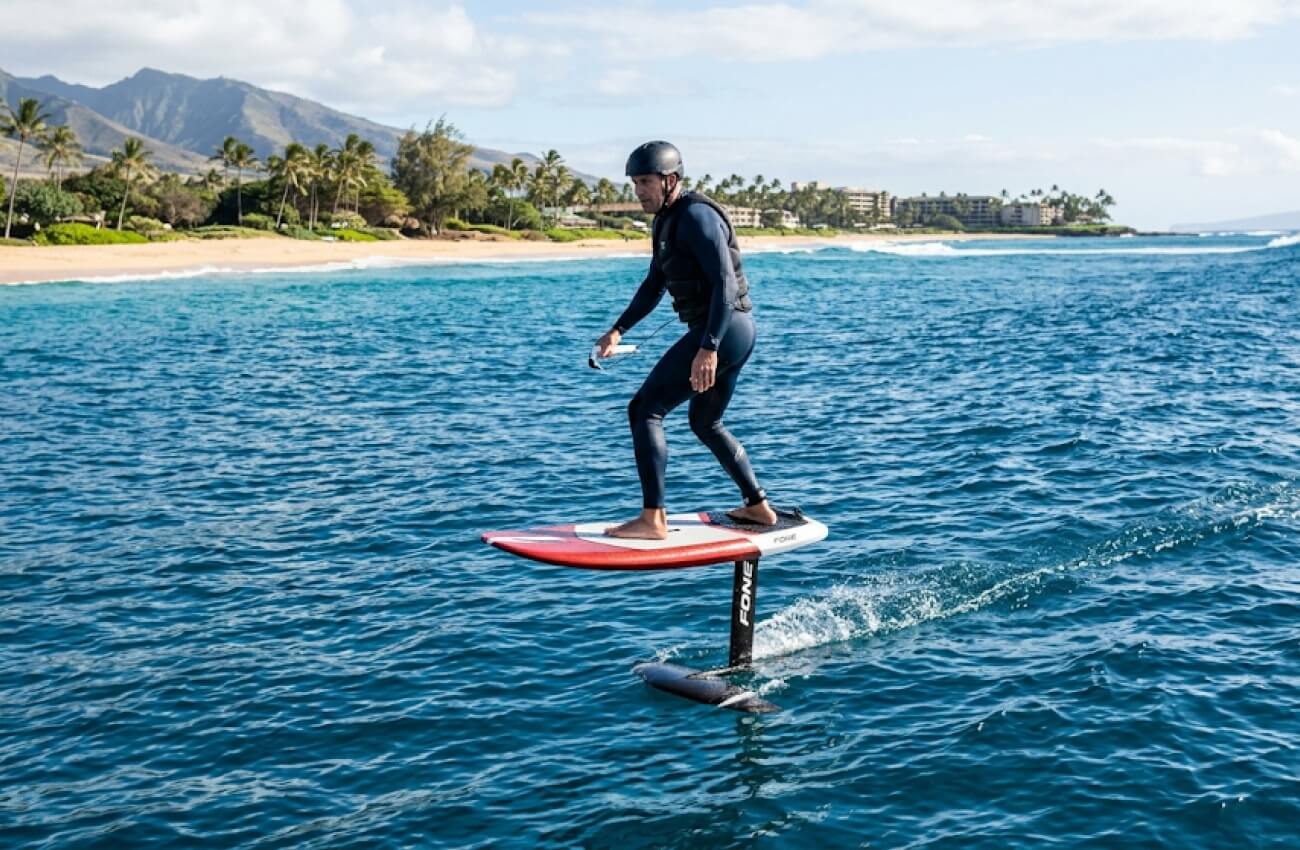
The transition from prone to standing happens in stages: knees first, then one foot forward, then upright. Each stage asks for a slightly different weight distribution, and the coach is talking through each one in your ear as you make it. By the thirty-minute mark in most sessions, students are standing, throttle open, watching the hull lift clear of the surface.
The sensation at that point is genuinely hard to describe without sounding like a cliché. The motor noise drops away because you’re no longer dragging through the water. The board stops reacting to surface chop. Everything gets smoother. You’re moving at speed over the water surface, not through it, and the only feedback you’re managing comes from your own weight and the throttle in your hand.
More than 80% of first-timers reach that point within their first session. For those who want to build on it, the intermediate class runs between 2,000 and 3,500 THB and focuses on directional control: edge management, throttle modulation through turns, recovering from altitude changes without losing the flight.
Phuket eFoil Season: Why Kata Beach Offers the Best Conditions
The Phuket efoil season runs April through October. During that window, the Andaman coast settles into flat, protected conditions on the west side of the island. Kata Bay in particular has a geometry that keeps chop down and gives instructors a clear sightline across the whole session area.
Water depth close to shore at Kata stays between 1.5 and 3 metres — enough clearance for the foil mast to operate without touching bottom, shallow enough that a fall doesn’t feel like an event. The seabed is sandy. That combination matters more than it sounds for a first session, because the environment you’re riding in affects how relaxed you are on the board, and relaxation affects how fast you progress.
The electric hydrofoil doesn’t require wind, which is a meaningful difference from kitesurfing or wing foiling. Calm, slightly overcast days with zero breeze are fine. Lessons only stop when swell is large enough to make the session area genuinely unsafe, which happens a handful of times per season.
If your trip runs November to March
The Andaman side of Thailand slows down in the northeast monsoon season, but efoil lessons on Koh Phangan at Chaloklum Beach run year-round. The bay faces north and stays sheltered through both monsoon directions. November to March is actually the peak window there — the water is calm, visibility is good, and conditions for first sessions are comparable to Kata at its best.
EasyFlyFoil runs both locations with the same equipment and the same session structure. If you’re splitting a trip between Phuket and the Gulf of Thailand islands, you can continue your progression across both without starting over.
The five-day package, starting from 8,500 THB, is designed specifically for that kind of intensive progression: from the first prone session to riding upright with directional control across a full week of training. Most people who complete it leave with enough skill to rent independently and continue on their own.
Bring a swimsuit, sunscreen, and a towel. We handle the rest.

E-foil surfing instructor
Hello, fellow sailors! My name is Anton and I am your guide in the world of surfing. Let’s dive into the waves together!